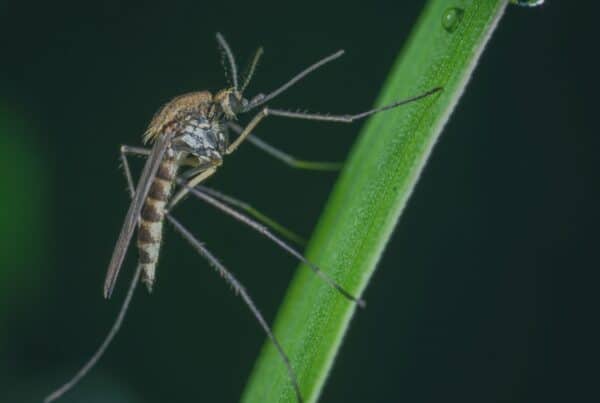

A mosquito that gets into your house can survive for several weeks, and in some cases up to a month or more, which is longer than it would typically live outdoors. Indoor conditions protect mosquitoes from the predators, wind, and temperature swings that shorten their lifespan outside.
At Inside & Out Pest Services, we treat mosquito problems across Jacksonville and St. Augustine all year, and indoor mosquitoes are one of the most common complaints we hear. If you’ve been swatting at the same buzzing sound for days and wondering if it’s really “still alive,” the answer is probably yes, and here’s why your home is such a good hiding spot for it.
Indoor vs. Outdoors Lifespan
Mosquitoes that stay outdoors typically live 2 to 3 weeks, while mosquitoes that get inside a house can survive for several weeks to about a month. Indoor environments are simply more stable. Your home holds a steady temperature, has fewer predators like birds, bats, and dragonflies, and often has small water sources mosquitoes need to breed, like pet bowls or drain trays.
Quick answer: An indoor mosquito can live for weeks, sometimes a month or more. Outdoors, most only make it 2 to 3 weeks.
Female mosquitoes kept in stable, lab-like indoor conditions survived for up to 56 days. Your house isn’t a lab, but a dark closet, laundry room, or bathroom under a sink comes close enough that a similar lifespan indoors isn’t unusual.
Male vs. Female Lifespan
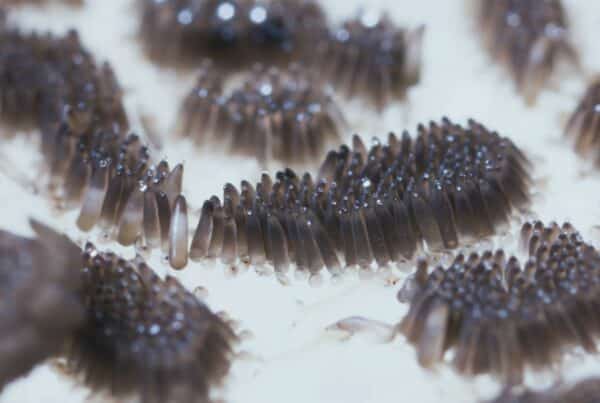
Male mosquitoes typically live 1 to 2 weeks, while female mosquitoes usually live 2 to 8 weeks and are responsible for the bites you notice. Males feed only on plant nectar and never bite, which is part of why their lifespan is shorter. Females need a blood meal to develop eggs, and a single female can lay 100 or more eggs per batch, then continue seeking additional blood meals to lay more.
That’s also why a lingering indoor mosquito is almost always female. If it’s still around after a week or two, it’s likely a female looking for both blood and a place to lay eggs, not a fluke.
| Mosquito type | Typical lifespan | Notes |
| Male, outdoors | 1–2 weeks | Feeds on nectar only, never bites |
| Female, outdoors | 2–3 weeks | Needs blood meals to lay eggs |
| Female, indoors | Several weeks to ~1 month | Stable temps + fewer predators extend lifespan |
| Female, overwintering | 6–8 months | Sheltered in garages, attics, or wall voids over winter |
Why Some Mosquitoes Survive for Months Indoors
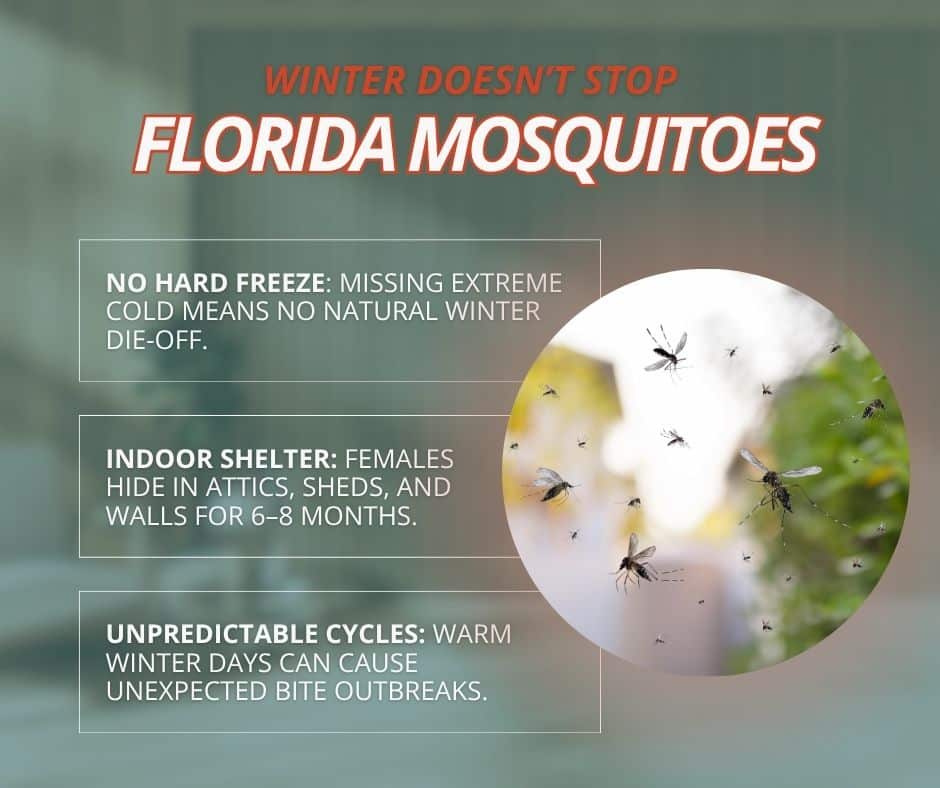
Certain mosquito species can survive for 6 to 8 months indoors through a process called overwintering, where mated females find a sheltered spot to wait out cold weather. Garages, attics, sheds, and wall voids are common overwintering spots.
In Northeast Florida’s mild winters, this cycle can be even less predictable than in colder states, since mosquitoes here rarely face a hard freeze that would otherwise force full dormancy or death.
What Attracts Mosquitoes Into Your House?
Mosquitoes get inside looking for three things: a blood meal, a place to lay eggs, and shelter from wind and predators.
| What draws them in | Where you’ll find it | Why it matters |
| Standing water | Pet bowls, plant saucers, clogged drains, fridge drip pans | Eggs can develop into biting adults in as little as 8–10 days |
| Dark, damp hideouts | Closets, under-sink cabinets, bathrooms, behind appliances | Cool, humid conditions are ideal for a resting mosquito |
| Body heat, sweat, CO2 | Bedrooms, especially at night | These signals are how mosquitoes track down a blood source |
Natural Ways to Shorten a Mosquito’s Stay
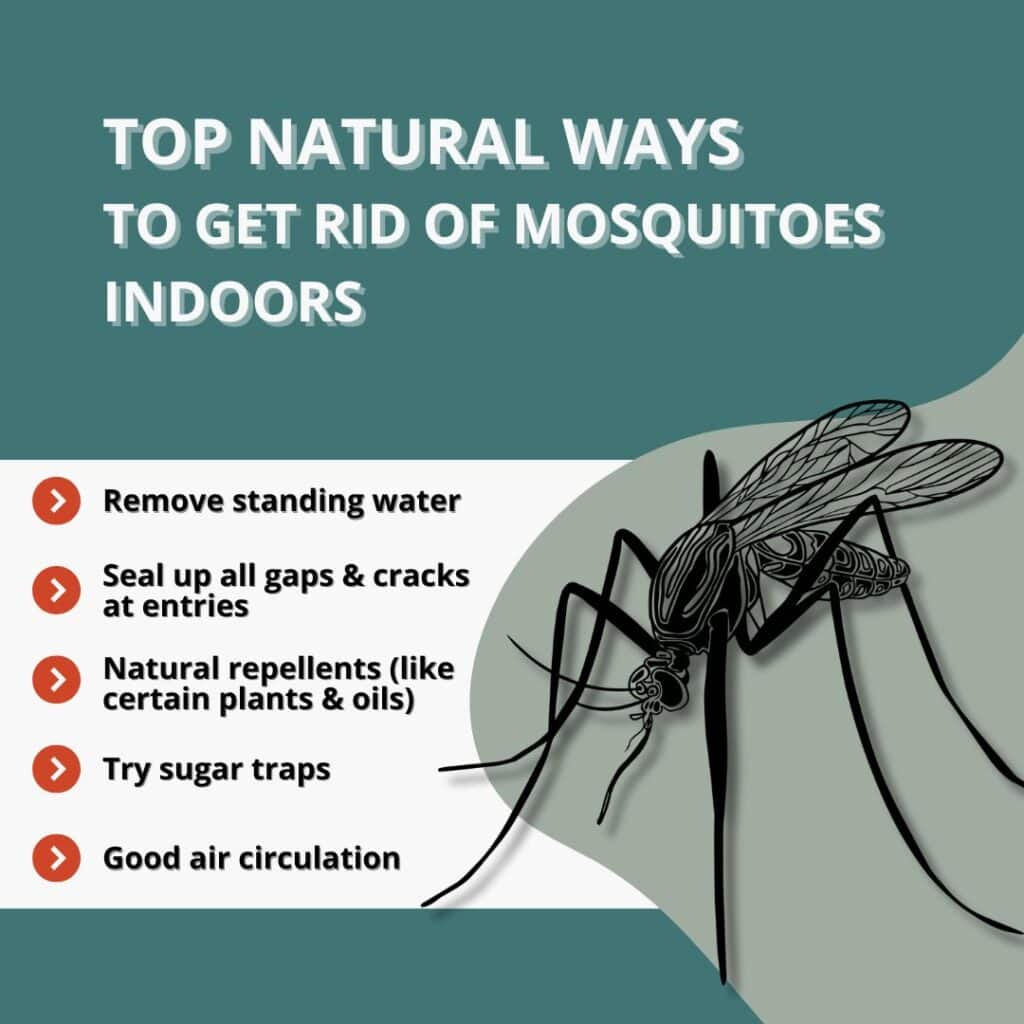
You can’t force a mosquito to leave once it’s inside, but removing what it needs to survive speeds up the process considerably. A few natural steps that make a real difference:
- Empty and dry pet bowls, plant saucers, and any small standing water daily.
- Check for leaks or standing water under sinks, behind the washing machine, and around window units.
- Repair damaged window and door screens, and add door sweeps to close gaps at the threshold.
- Seal cracks where pipes or cables pass through exterior walls.
- Place mosquito-repelling plants, like lavender, mint, or basil, near entry points as an added deterrent.
These steps won’t eliminate an established indoor population overnight, but they remove the standing water and shelter mosquitoes rely on to survive weeks (or months) inside instead of dying off in days.
Related Questions to Explore
- Can a mosquito lay eggs inside my house? Yes, if there’s standing water anywhere indoors, even a small amount in a plant saucer or clogged drain. Eggs can develop into biting adults in as little as 8 to 10 days, which is why removing hidden water sources matters as much as removing the adult mosquitoes you can see.
- Why do I still have mosquitoes after I sprayed? A spray only kills mosquitoes it directly contacts. If eggs or larvae are already developing in a hidden water source, new adults will keep appearing days later even after a thorough spray. Bug zappers won’t help either, since mosquitoes aren’t drawn to the UV light those devices use. For professional guidance, check out our mosquito control service.
- Do mosquitoes die on their own if I just wait? Eventually, but “eventually” can mean weeks, and an overwintering female could last months. Waiting also gives a female time to lay eggs indoors, which restarts the cycle. It’s faster to remove standing water and shelter than to wait it out.
- What time of year are indoor mosquitoes worst in Florida? Mosquito pressure peaks in the summer in Northeast Florida but lingers well into fall, and our mild winters mean indoor mosquito problems rarely disappear completely the way they might in colder states. Natural predators like dragonflies help outdoors, but they can’t reach the ones already inside your home.
When to Call a Professional
If natural prevention steps aren’t clearing up an indoor mosquito problem within a week or two, or if you’re finding mosquitoes indoors repeatedly across multiple rooms, it’s a sign of an established breeding source rather than a single mosquito that wandered in.
Our technicians inspect for hidden breeding sites you might not think to check, then treat to reduce mosquitoes at every stage of growth, not just the adults you can see.
Inside & Out Pest Services has served Jacksonville, St. Augustine, and the surrounding Northeast Florida area for over 20 years, and mosquito treatment is one of our most requested services heading into summer.
Conclusion
A mosquito indoors can live for weeks, and in some cases months, because your home gives it the stable temperature, shelter, and standing water it needs to outlast its usual outdoor lifespan. Removing those three things (water, hiding spots, and access points) is the fastest way to shorten how long it sticks around.
If indoor mosquitoes keep coming back no matter what you try, reach out to Inside & Out Pest Services, and we’ll find the breeding source natural prevention alone can miss.