
Florida is home to more bug species than most states, and Jacksonville homeowners know firsthand how easy it is to spot something skittering across the floor and immediately assume the worst. But not every dark, fast-moving bug is a cockroach.
Several common Florida pests share enough physical traits with roaches that even careful homeowners get them wrong.
Knowing the difference matters because the right identification leads to the right response.
Why So Many Florida Bugs Get Mistaken for Cockroaches
Cockroaches have a recognizable profile: a flat oval body, long antennae, six legs, and dark reddish-brown or black coloring. The problem is that a surprising number of other insects share one or more of those traits.
Florida’s warm, humid climate also means many of these bugs are active year-round and end up in the same places roaches like to hide: garages, bathrooms, under sinks, and along exterior walls.
The key to telling them apart is looking beyond color and size. Body shape, leg structure, behavior, and where you find the bug all help narrow it down quickly.
Florida Bugs That Look Like Cockroaches
Here is a quick reference before we break each one down:
| Bug | Size | Color | Where You’ll Find It | Threat Level |
| Giant Water Bug | 1.5–4 inches | Dark brown | Ponds, puddles, near lights | Low indoors |
| Stink Bug | 0.5–0.75 inches | Mottled brown | Gardens, windows, walls | Nuisance only |
| Asian Longhorned Beetle | 0.75–1.5 inches | Shiny black with white spots | Trees, wooded areas | Harmful to trees |
| Mole Cricket | 1–1.5 inches | Dark brown | Lawns, soil, mulch beds | Lawn damage only |
| May Beetle (June Bug) | 0.5–1 inch | Reddish-brown | Near outdoor lights | Nuisance only |
| Ground Beetle | 0.5–1.5 inches | Black or dark brown | Under mulch, debris, logs | Beneficial |
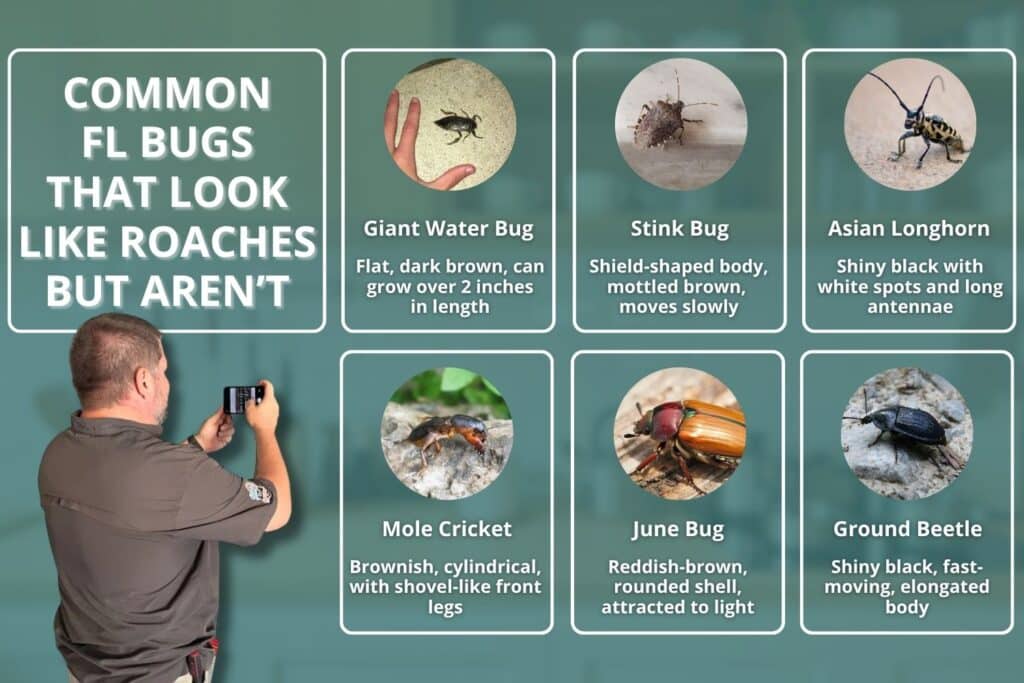
1. Giant Water Bug
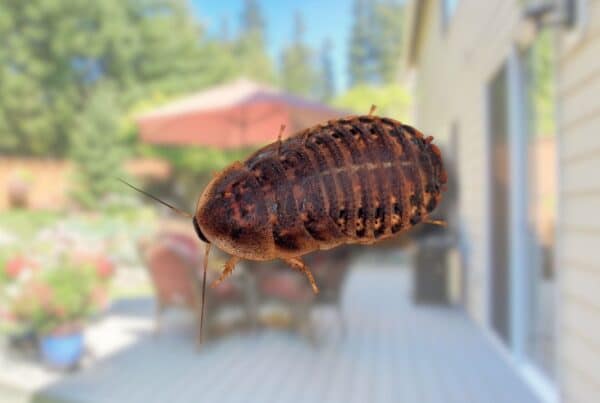
The giant water bug is one of the most alarming lookalikes simply because of its size. These insects can grow over two inches long with a wide, flat, dark brown body that draws an immediate cockroach comparison.
The key difference is behavior. Giant water bugs are aquatic predators that live in ponds, drainage areas, and slow-moving water. They do not infest homes.
If you find one inside, it almost certainly flew in at night, drawn by outdoor lighting, which is common near retention ponds and wooded lots throughout the Jacksonville area.
How to tell it apart: Look for paddle-shaped rear legs built for swimming and a pointed tip at the abdomen. No cockroach has either of these features.
2. Stink Bug
Stink bugs are most commonly found in Florida during cooler months when they push inside seeking warmth. Their brownish coloring and flat profile can read as cockroach-like in poor lighting or at a quick glance.
Up close, the differences are clear. Stink bugs have a distinctive shield or triangular shape when viewed from above, speckled patterning on their back, and move much more slowly than roaches.
Their most obvious giveaway is the strong, unpleasant odor they release when threatened or crushed, something cockroaches do not do. They are a nuisance pest and not a health or structural concern.
How to tell it apart: Shield-shaped body, mottled pattern, and defensive odor. Cockroaches are oval, glossy, and produce no smell.
3. Asian Longhorned Beetle
The Asian longhorned beetle’s shiny black body causes occasional confusion, particularly when found near the exterior of a home. At first glance, the dark, glossy appearance is similar enough to trigger concern.
A closer look settles it immediately. This beetle has striking white spots across its body and extremely long banded antennae that extend two to three times its body length.
It is an invasive species and a threat to hardwood trees, not homes. If you spot one in your yard, the concern is your trees, not an indoor infestation.
How to tell it apart: White spots and dramatically long banded antennae. No Florida cockroach species looks like this up close.
4. Mole Cricket
Mole crickets are brownish, roughly an inch to an inch and a half long, and move quickly, which can cause a double-take at night on a patio or garage floor. Their coloring and general shape overlap enough with cockroaches that the confusion is understandable.
The differences are obvious once you look closer. Mole crickets have large shovel-like front legs built for digging through soil, a feature no cockroach shares.
Their bodies are also more cylindrical than flat. Across the Jacksonville area, where St. Augustine grass is common, mole crickets are a known lawn pest but not a household one.
How to tell it apart: Enlarged, shovel-shaped front legs and a rounded cylindrical body. Cockroaches are flat with uniform legs and no digging adaptations.
5. May Beetle (June Bug)
May beetles, commonly called June bugs, are reddish-brown with a hard, rounded shell, and their size and color can prompt a quick cockroach alarm. They are especially common on warm Florida evenings around porch lights.
June bugs are clumsy fliers that buzz erratically and frequently end up on their back trying to right themselves.
Cockroaches move deliberately and fast, and actively avoid light rather than seeking it out. June bugs feed on plant foliage and pose no threat to your home or health.
How to tell it apart: Rounded hard shell, clumsy flight, and attraction to light. Cockroaches are flat, fast, and flee from light.
6. Ground Beetle
Ground beetles are the most frequent roach impostors inside Florida homes. They are black or very dark brown, shiny, and move quickly across floors, which checks nearly every visual box that triggers a cockroach alarm.
The good news is that ground beetles are beneficial insects that feed on other pests, including ants and small larvae. They live under mulch, logs, and leaf litter outdoors and do not establish colonies inside. When one turns up inside, it wanders in through a gap or open door and is not looking to stay.
How to tell it apart: Ground beetles have a narrower, more elongated body with legs positioned further back than a cockroach’s. They also tend to freeze when encountered rather than sprinting for the nearest crack.
How Do You Confirm Whether You’re Dealing With a Cockroach?
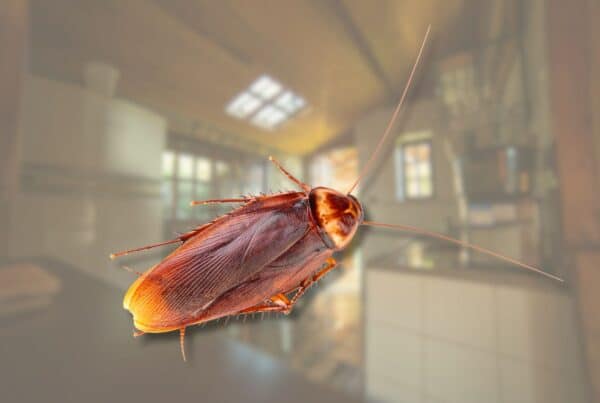
If you are still not sure what you found, here are the traits that confirm a true cockroach: a flat oval body with a leathery texture, antennae roughly as long as or longer than the body, six legs with visible spines, and fast, directed movement toward dark cracks and crevices when disturbed.
In Florida, the three most common species are the American cockroach (large, reddish-brown), the German cockroach (small, tan with two dark stripes behind the head), and the Florida woods cockroach, sometimes called the palmetto bug.
If it ran directly under your refrigerator or vanished into a cabinet crack, that behavior alone is a strong indicator you are dealing with the real thing.
Related Questions
What is the difference between a wood roach and a regular cockroach?
Wood roaches are a distinct species commonly found outdoors throughout Northeast Florida. They occasionally wander inside but do not establish indoor colonies the way German or American cockroaches do. Finding one or two near a doorway is usually a different situation than finding cockroach droppings or egg cases inside a cabinet.
How do you get cockroaches out of a house once they are inside?
German cockroach infestations in particular require more than over-the-counter sprays. Gel baits, insect growth regulators, and targeted void treatments are typically needed to reach the nest and interrupt the reproductive cycle. A professional inspection identifies where the population is concentrated so treatment can be applied effectively.
Are there other pests in Florida that are easy to misidentify?
Yes. Winged ants are frequently mistaken for termites, which is a misidentification with significant consequences since termites cause structural damage that can go undetected for years. Tiny black bugs of various species are also routinely confused with one another. Correct identification is the starting point for any effective pest control response.
Can mosquitoes or other outdoor pests eventually become an indoor problem?
Mosquitoes typically do not establish themselves indoors, but they do move inside through gaps, torn screens, and open doors, which is a common issue in Jacksonville’s humid climate. Other outdoor pests, like rodents, are more likely to become true indoor problems when entry points go unaddressed. General pest control combined with exclusion work covers both scenarios.
When to Call a Professional
Most of the bugs on this list are not cause for alarm. But there are situations where professional help is the right call:
- You have found multiple bugs of the same type over several days
- You have seen insects running into wall voids, behind appliances, or under cabinets
- You have found droppings, egg cases, or shed skins alongside the bug
- You cannot confidently identify what you are dealing with
Misidentification leads to the wrong treatment. A pest professional does not just treat the problem; they confirm exactly what it is first. That distinction matters, especially with German cockroaches, which are rarely found alone and almost never present without a nearby breeding population.
Inside & Out Pest Services has served Jacksonville, St. Augustine, Orange Park, Ponte Vedra Beach, and communities throughout Northeast Florida for over 20 years.
Conclusion
Florida’s bug diversity means that not everything startling is worth a full-scale response. Giant water bugs, stink bugs, Asian longhorned beetles, mole crickets, June bugs, and ground beetles all share enough traits with cockroaches to cause confusion, but none of them represent the same threat to your home or health.
Taking a second look before reacting saves time, money, and unnecessary stress. And when you confirm it is the real thing, or when you simply are not sure, Inside & Out Pest Services is ready to help you get the right answer and the right treatment.