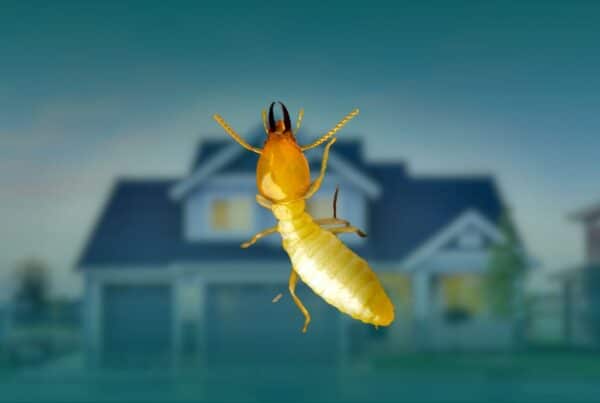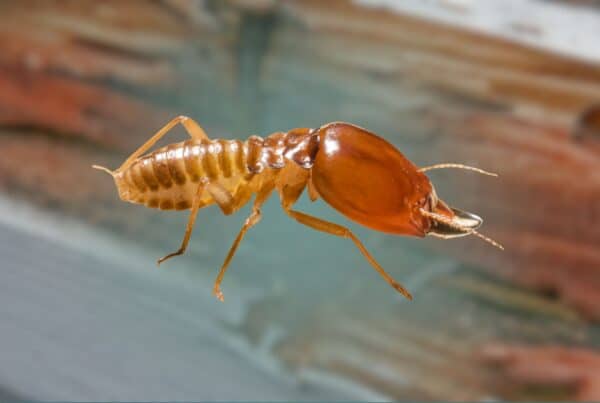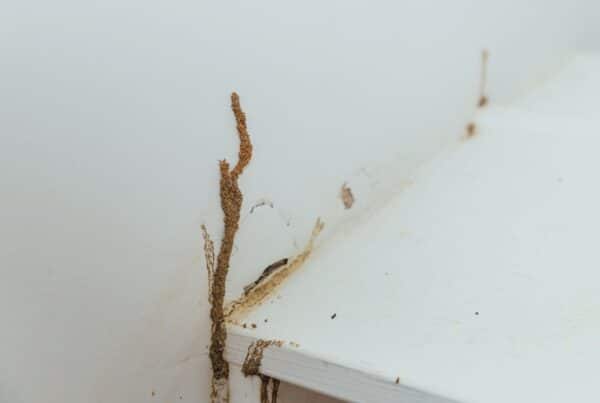

Termite mud tunnels are narrow, pencil-width tubes made of soil, wood particles, and termite saliva that subterranean termites build to travel safely between their underground colony and the wood in your home.
Finding one on your foundation is a clear sign of active subterranean termite activity and means a colony is already feeding nearby.
At Inside & Out Pest Services, mud tubes are one of the most common things our Jacksonville-area inspection team finds during annual termite checks.
What Are Termite Mud Tunnels?
Termite mud tunnels, also called mud tubes or shelter tubes, are covered passageways that subterranean termites construct above ground. They connect a termite colony’s underground nest to its food source, typically the wood framing, floor joists, or subfloor of your home.
The tubes are made from a mixture of soil, wood fragments, termite feces, and saliva. That combination creates a sturdy, cement-like material that holds moisture and blocks light. Most tubes are roughly pencil-width, around 3 to 6 millimeters in diameter, though heavily trafficked working tubes can widen over time.
According to the University of Florida IFAS Extension, subterranean termites build mud tubes from soil, saliva, and excrement to protect themselves from drying out and from predators as they travel. Homes in Florida should be inspected at least once a year for evidence of these tubes.
Only subterranean termites build mud tubes. Drywood termites, which are also common in Florida, live entirely inside the wood they consume and leave different evidence behind.
Why Do Termites Build Mud Tunnels?
Mud tunnels exist for one core reason: subterranean termites cannot survive in open air. Without a covered path, workers would dehydrate and die within hours of exposure to normal outdoor humidity levels.
The tubes they build will serve three specific functions:
1) Moisture control
The enclosed structure traps humidity, keeping the interior at nearly 98% relative humidity, which is the level subterranean termites need to survive. Open air in Florida typically runs 30 to 60% humidity, far too dry for exposed workers.
2) Predator protection
Ants are the primary natural predator of termites. Mud tubes keep foraging workers hidden and prevent ant raids on the colony’s food-gathering routes.
3) UV and heat shielding
Direct sunlight kills worker termites quickly. The opaque walls of a mud tube block light entirely and buffer against temperature swings between the cool soil and the warmer above-ground environment.
Together, these three functions allow a subterranean termite colony to forage far from its nest. A mature colony can extend mud tubes more than 100 feet to reach a food source, often doing so entirely out of sight under flooring, inside wall cavities, or behind drywall.
How Termites Build Their Mud Tunnels
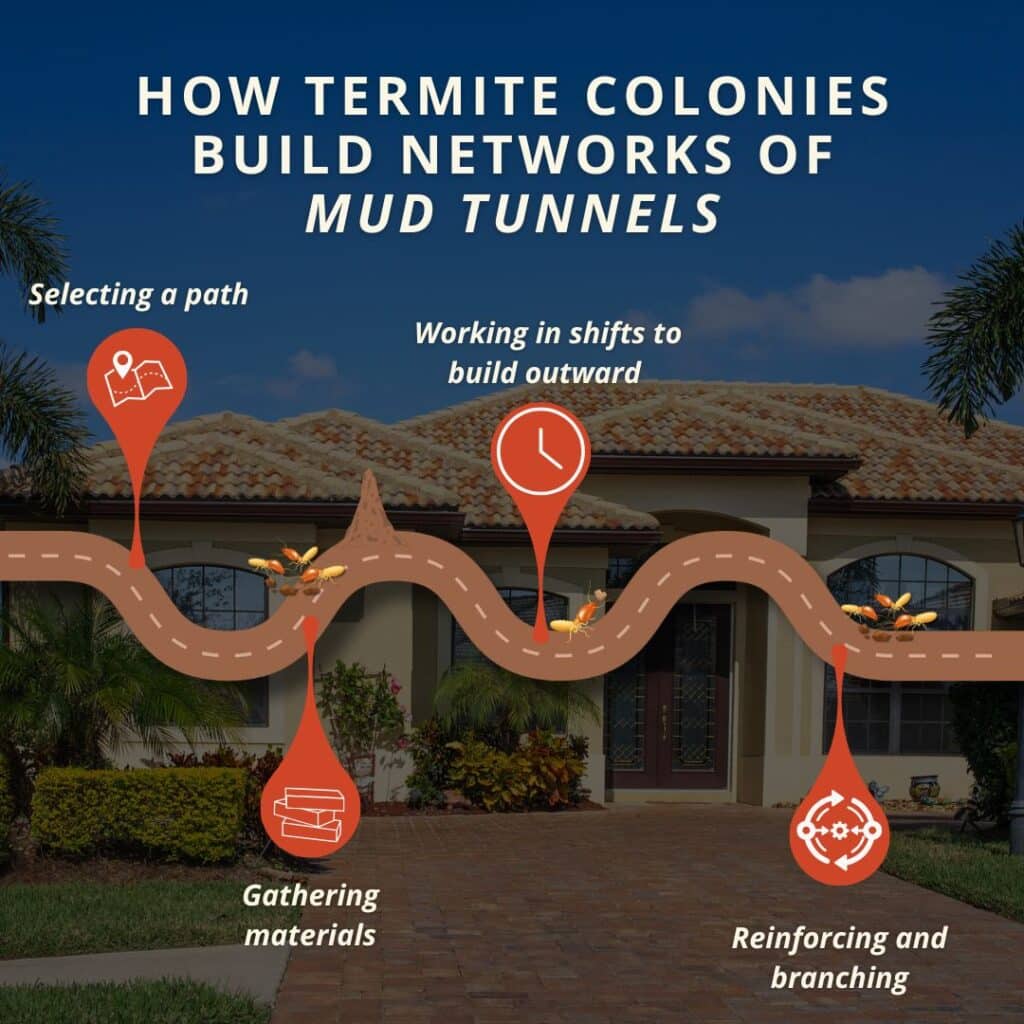
Worker termites do all the construction. They gather soil particles from the ground, mix in wood fragments and their own saliva, and deposit the material in small increments along a chosen path. The saliva acts as a binder, hardening the mixture into a firm but slightly flexible structure.
Construction typically begins at the nest and moves outward toward a food source. Workers build in shifts, extending the tube in small sections. Once a path reaches wood, they branch off as needed to access new feeding areas, creating a network that can span multiple rooms or floors.
If a tube is damaged or broken, workers repair it quickly. An active colony can rebuild a broken section within 24 to 72 hours.
The Four Types of Termite Mud Tunnels
Not all mud tubes are the same. Termites build four distinct types, and each one tells you something different about where the colony is and what it’s doing.
Working Tubes
Working tubes are the main highways of a termite colony. They run from the soil to a wood source and carry heavy daily traffic from foraging workers. These are the most commonly found tubes during home inspections and are typically the widest, strongest, and most well-maintained.
Finding a working tube means an active colony is feeding on your home.
Exploratory Tubes
Exploratory tubes are thinner and more fragile than working tubes. Worker termites build these when scouting for new food sources. They branch out in multiple directions and often end abruptly if no food is found.
Colonies quickly abandon them once a better route is established. Though they look insignificant, exploratory tubes confirm that termites are actively searching your property.
Drop Tubes
Drop tubes hang downward from wood structures toward the soil, essentially the reverse of a working tube. They appear when a colony is well-established above the ground level, often found hanging from floor joists, ceiling beams, or subflooring.
Drop tubes are a sign that termites have already accessed the structure and are working their way deeper into it.
Swarm Tubes
Swarm tubes, sometimes called swarm castles, are wider structures built near existing tube networks. Termite colonies construct them as staging areas for alates, the winged reproductive termites that leave the colony to start new ones. If you find swarm tubes alongside discarded wings on windowsills or floors, the colony is mature and actively spreading.
In Jacksonville and Northeast Florida, peak subterranean termite swarming runs from January through May.
Where You Might Spot Mud Tunnels in Your Home
Subterranean termites always need a path from soil to wood, so mud tubes appear anywhere those two things come close together. Common spots to check:
- Foundation walls and slab edges: The most common location. Look for pencil-width trails running vertically up the foundation.
- Crawl spaces: Check along the sill plate, floor joists, support piers, and anywhere pipes penetrate the floor.
- Garage walls and interior walls: Termites can enter through cracks in the concrete slab or expansion joints.
- Plumbing and HVAC penetrations: Anywhere a pipe or duct runs through the floor creates a potential entry route.
- Exterior wood near soil: Deck posts, wooden steps, and wood siding that contacts the ground are common starting points.
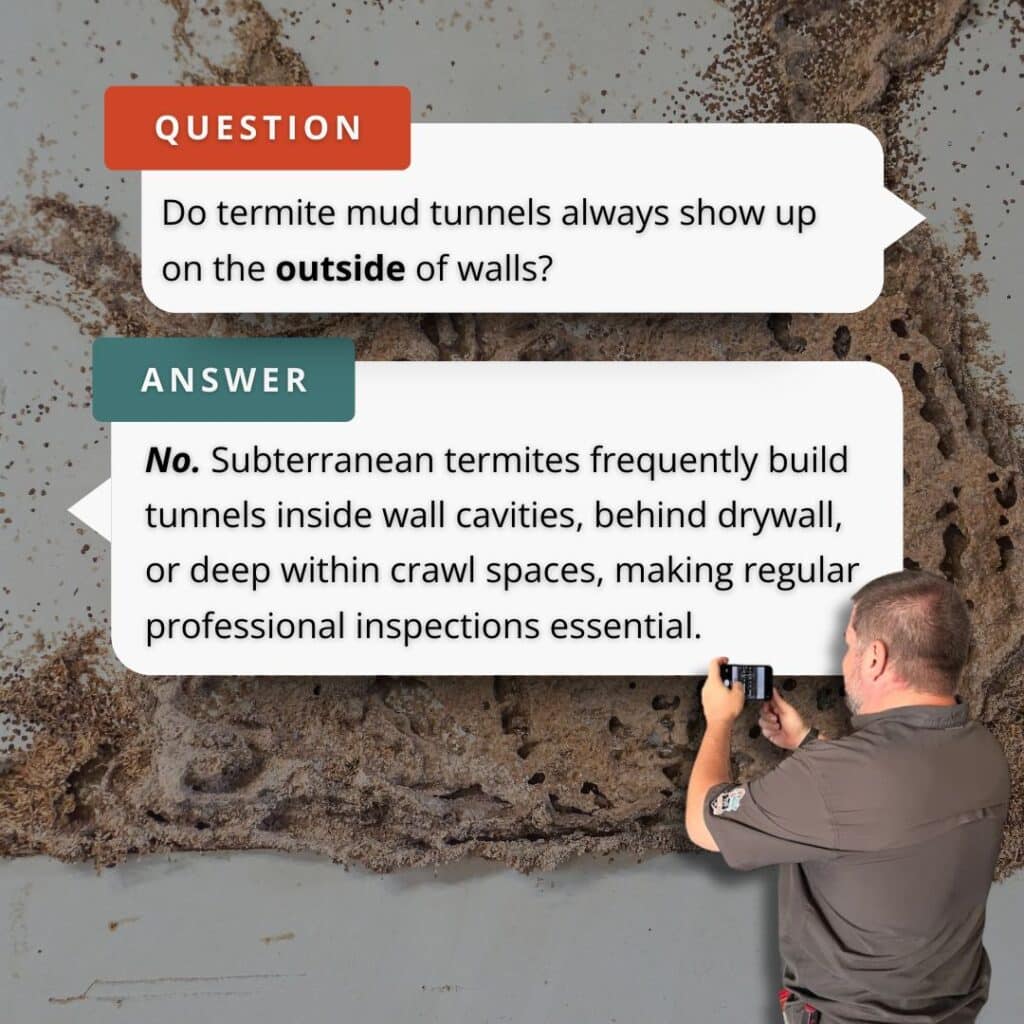
Mud tubes are not always visible from a standing position. Check low on walls, under stairs, and inside cabinets against exterior walls. A thorough termite inspection requires getting into the crawl space and examining the underside of the floor structure. Our team in Jacksonville covers all of these areas during a full inspection.
How to Tell If a Mud Tunnel Is Active
Finding a mud tube doesn’t automatically mean the colony is still active. Tubes can remain in place long after a colony has died or been treated. Here’s how to check:
- Choose a section of the tube that is easily accessible.
- Use a small tool to break away a 1-inch section from the middle of the tube.
- Mark the date and check back every 24 hours for the next 3 days.
- Active tube: The broken section is repaired or rebuilt within 24 to 72 hours, or you see live, cream-colored worker termites when you break it open.
- Inactive tube: The break stays open, the remaining tube is dry and brittle, and it crumbles easily. Inactive tubes are lighter in color than active ones, which remain dark and slightly moist.
One important note: an inactive tube does not mean the problem is resolved. The colony may have shifted its foraging route, but not abandoned the structure. A professional inspection is still the right call, especially if you have no record of prior termite treatment on the property.
For a broader look at what termite activity looks like inside a home, see our post on identifying termite frass and other infestation signs.
Other Signs of Termites to Watch For
Mud tubes are one of the most visible indicators, but subterranean termites leave other evidence too. Watch for these alongside any tube activity:
- Hollow-sounding wood: Tap wooden walls, floors, or trim. A hollow sound where the wood should be solid indicates tunneling inside.
- Discarded wings: Swarmers shed their wings after landing. Small piles of equal-length wings near windows, doors, or on floors are a reliable sign. See our full breakdown of what homeowners should know about termites with wings.
- Frass: Drywood termites (not subterranean) push hexagonal pellets called frass out of kick-out holes in wood. Subterranean termites incorporate frass into their tubes rather than ejecting it.
- Blistered or warped wood: Surface damage to floors, baseboards, or walls that looks like water damage but has no moisture source.
- Tight-fitting doors and windows: Termite tunneling inside door frames or window casings can cause them to warp and stick.
How to Reduce Your Risk
No prevention method eliminates termite risk entirely in Northeast Florida, but these steps reduce the conditions that attract subterranean termites to your home:
- Remove wood-to-soil contact. Keep siding, deck posts, and fence posts elevated above ground and away from direct soil contact.
- Fix moisture problems. Leaky pipes, poor drainage, and clogged gutters all create the damp conditions subterranean termites need. Repair them promptly.
- Store firewood off the ground and away from the house. Keep it at least 20 feet from the foundation.
- Ventilate crawl spaces. Proper airflow reduces humidity and makes the space less hospitable.
- Keep mulch away from the foundation. A 12-inch gap between mulch and the sill plate removes a common moisture bridge.
- Schedule annual termite inspections. Early detection costs far less than structural repair. Our Jacksonville termite inspection service catches activity before it reaches the framing.
Related Questions to Explore
How do I know if a termite mud tube is active? Break off a 1-inch section from the middle of the tube and check back in 24 to 72 hours. If termites have repaired the break, the tube is active. If you see live, cream-colored workers when you open it, the colony is active.
A dry, brittle tube that stays broken suggests inactivity, though a professional inspection is still recommended.
Do all termites in Florida build mud tubes? No. Mud tubes are built exclusively by subterranean termites, which live in underground colonies and must stay moist to survive. Drywood termites, also common in Florida, live entirely inside the wood they consume and do not build mud tubes.
If you find mud tubes, you are dealing with subterranean termites. For a broader comparison of wood-destroying insects, see our post on carpenter ants vs termites.
Should I break a termite mud tube if I find one? You can break a small section to test for activity, as described above. Breaking it will not stop the infestation or cause the termites to leave. Do not remove the entire tube before a professional has inspected it, as the tube’s location and condition help technicians assess the extent of the colony’s foraging routes.
What is the difference between termite mud tubes and drywood termite damage? Subterranean termites build mud tubes on the surface of structures. Drywood termites leave no external tubes. Instead, they push small hexagonal pellets called frass out of kick-out holes in infested wood. If you have tubes, it’s subterranean termites. If you have frass piles with no tubes, it’s more likely drywood termites.
When to Call a Professional
Any time you find a mud tube, active or not, a professional inspection is the right next step. Here’s why: mud tubes that look inactive may reflect a shifted foraging route, not a resolved infestation. And even if the colony is gone, the structural damage it caused may still be present.
Call a professional if:
- You find mud tubes anywhere on the foundation, crawl space, garage, or interior walls.
- You see other signs of termite activity alongside the tube: discarded wings, hollow wood, frass, or warped surfaces.
- Your home has never had a termite inspection or it has been more than a year since the last one.
- You are buying or selling a home (a termite inspection is typically required by lenders in Florida).
At Inside & Out Pest Services, our Jacksonville team performs full inspections of the foundation, crawl space, and accessible interior areas. We identify active and historic tube activity, locate entry points, and recommend treatment options based on what we find.
Conclusion
Termite mud tunnels are not just dirt on your wall. They are the active infrastructure of a subterranean termite colony working its way into your home’s structure. The sooner they’re found, the less damage the colony has done.
Key takeaways:
- Mud tubes are built exclusively by subterranean termites and always mean a colony is nearby
- There are four types, each indicating a different stage of colony activity
- Test for activity by breaking a small section and checking for repair within 72 hours
- Annual inspections catch tubes early, before structural damage accumulates
If you’ve found a mud tube or want to make sure your home is clear, schedule a termite inspection with Inside & Out Pest Services in Jacksonville and surrounding Northeast Florida communities today.