
If you’ve spotted tiny red bugs in your Florida home or yard, the most common culprit is the clover mite: a harmless, plant-feeding arachnid that invades in large numbers.
That said, several other tiny red bugs show up in the Sunshine State, some harmless and some not. This guide covers the most common types, how to tell them apart, and what to do about each one.
At Inside & Out Pest Services, we work with Jacksonville homeowners dealing with these exact pests year-round.
What Do We Mean By “Tiny Red Bugs”?
“Tiny red bugs” will almost always refer to a type of mite, which puts them in the arachnid family alongside spiders and ticks.
Typically, they are not insects.
Most species you’ll find in Florida are either clover mites or chiggers, though a few others show up regularly, too. Knowing which one you’re dealing with changes everything about how you respond.
Common Tiny Red Bugs in Florida
Florida’s warm, humid climate gives several mite species the conditions they need to thrive year-round. Here’s a breakdown of the most common ones.
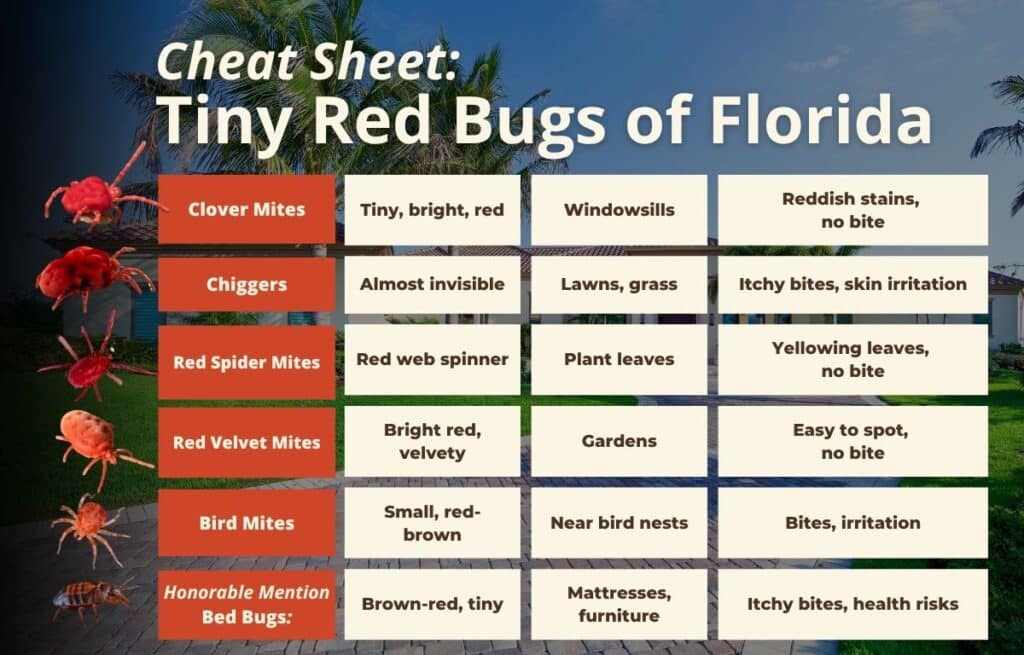
Clover Mites
Clover mites are the tiny, bright red specks most Florida homeowners see on windowsills, walls, and siding. They measure about 0.75 mm, roughly the size of a pinhead, and have eight legs with a front pair noticeably longer than the rest. Those front legs are often mistaken for antennae.
Key traits:
- Bright red to reddish-brown color
- Oval body with feather-like plates on the abdomen
- Leave a red stain if crushed (this is pigment, not blood)
- Do not bite humans or pets
- Feed on grass, clover, and other plant material
Clover mites typically invade in spring and fall, when temperatures shift in North Florida. They come indoors through cracks around windows and doors and can appear by the hundreds on warm-facing walls.
Chiggers
Chiggers are the larval stage of a type of harvest mite (family Trombiculidae) and are almost invisible to the naked eye at less than 1/150 of an inch. Despite their size, their bites are hard to miss.
Key traits:
- Bright red larvae; adult chiggers are larger and don’t bite
- Found in grassy, wooded, or shaded outdoor areas
- Bite by injecting enzymes that break down skin cells
- Bites cause intense itching, red welts, and small blisters, often appearing at the waistline, ankles, and behind the knees
- Do not survive indoors
Per the National Pest Management Association, chiggers are active nearly year-round in warm southern states like Florida, with peak activity during the hottest months.
If you’re getting bitten and seeing red bugs outdoors in grassy areas, chiggers are the likely cause. If you’re seeing red specks on your windowsills and not getting bitten, you almost certainly have clover mites.
Red Spider Mites
Red spider mites (Tetranychus urticae) are a gardener’s problem rather than a homeowner’s. They prefer the underside of plant leaves and spin fine webs across leaf surfaces. If your houseplants or garden plants are yellowing with tiny speckled damage, spider mites are a top suspect.
Key traits:
- Extremely small, prefer plants
- Spin fine webbing on leaf undersides
- Do not bite humans
- Thrive in hot, dry conditions
Red Velvet Mites
Red velvet mites are larger and more visible than the others, with a striking, bright red, velvety body. You’re most likely to spot them outdoors on soil, sidewalks, or garden beds, especially after rain.
Key traits:
- Bright red with a velvety texture
- Larger than clover mites
- Harmless to humans and found mostly outdoors
- Actually beneficial: adult velvet mites eat other mites and insect eggs
Bird Mites
Bird mites don’t start out red, but they can appear reddish-brown after feeding on blood. If you have bird nests near or on your home and start noticing tiny biting bugs indoors, bird mites are worth investigating.
Key traits:
- Semi-transparent to brown; reddish after feeding
- Bite humans when their bird host is gone (fledged or dead)
- Can survive indoors for several weeks
- Often linked to attic infestations with active bird nests
Check your eaves, attic vents, and AC returns for nesting activity if bird mites are suspected. Our pest control services cover bird mite infestations alongside the usual suspects.
Clover Mites vs. Chiggers: The Biggest Mix-Up
Clover mites and chiggers get confused constantly because they’re both tiny and red.
Here’s how to tell them apart at a glance:
| Feature | Clover Mites | Chiggers |
|---|---|---|
| Size | ~0.75 mm (barely visible) | ~0.2 mm (nearly invisible) |
| Color | Bright red to reddish-brown | Bright red (larvae) |
| Where you find them | Windowsills, walls, siding | Grassy and wooded outdoor areas |
| Do they bite? | No | Yes (larvae only) |
| Survive indoors? | Briefly, no food source | No |
| Leave a stain? | Yes (red pigment when crushed) | No |
| Signs of their presence | Red specks crawling on surfaces | Itchy welts after outdoor time |
The simplest rule: if you’re seeing red bugs inside and not getting bitten, you have clover mites. If you’re getting bitten outdoors in grassy areas and have itchy welts near your waistline or ankles, chiggers are the culprit.
Read more about what a flea infestation looks like to the human eye if you’re also dealing with biting pests on your pets.
Where You’ll Find Tiny Red Bugs in Your Home and Yard
Different tiny red bugs show up in different places. Knowing the location helps narrow down which one you have.
- On windowsills and walls: Almost always clover mites. They seek warmth and enter through gaps around windows and doors, especially on the sunny sides of buildings.
- In grassy or wooded areas outdoors: Chiggers. They live in tall grass, leaf litter, and the edges of wooded areas. Jacksonville-area parks, nature trails, and overgrown yards are common chigger habitats.
- On plants and garden soil: Red spider mites (look for webbing and leaf damage) or red velvet mites (look for large red dots moving across soil and walkways).
- Near bird nests or attic spaces: Bird mites, especially after a nest is abandoned or fledglings leave.
- In mattresses, baseboards, or furniture: If the red-brown bugs are larger and flat-bodied, check for bed bugs.
Our team has written more about small insects that Florida homeowners start seeing in spring, if you’re trying to sort through a broader pest situation.
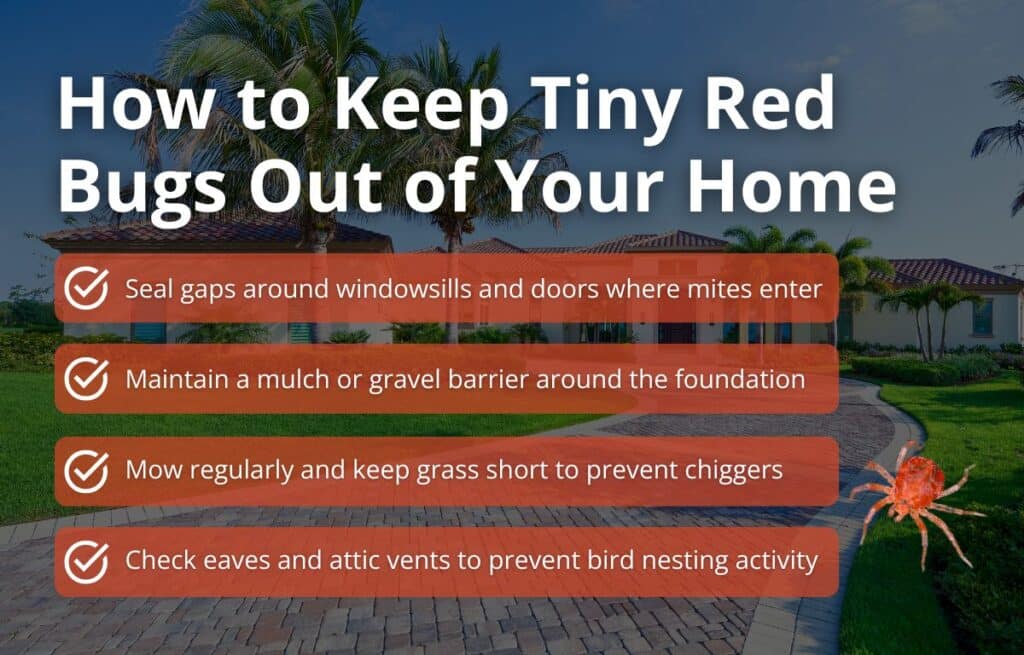
How to Keep Tiny Red Bugs Out
Most tiny red bug problems come down to a few preventable conditions. Here’s what to address first.
Clover mites:
- Create a 12-18 inch bare-soil or mulch barrier between your lawn and foundation (no grass or ground cover right against the house)
- Seal cracks around windows, doors, and siding with caulk
- Avoid over-fertilizing your lawn, as nitrogen boosts clover mite populations
- Vacuum up any mites you see indoors rather than crushing them (crushing leaves red stains)
Chiggers:
- Mow grass regularly and keep it below 3 inches
- Clear leaf litter and brush from yard edges
- Wear long pants tucked into socks and apply DEET-based repellent before walking in wooded or grassy areas
- Shower and wash clothing promptly after outdoor activities
- Create a mulch or gravel barrier between wooded areas and your lawn
Red spider mites:
- Water plants consistently (spider mites thrive in dry conditions)
- Apply neem oil or insecticidal soap to affected plants
- Remove heavily infested plants to prevent spread
Bird mites:
- Remove or seal off active bird nests before they become a problem (check local regulations on bird nest removal first)
- Seal attic vents and eaves to prevent nesting
Related Questions to Explore
What are the tiny red bugs crawling on my windowsill? The tiny red bugs on your windowsill are almost certainly clover mites. They are harmless, plant-feeding arachnids that enter homes through gaps near windows and doors, especially in spring and fall. They don’t bite, but they can leave red stains when crushed, so vacuum them up instead.
Do any tiny red bugs bite humans? It depends on the species. Clover mites do not bite and are harmless to people. Chigger larvae do bite, injecting enzymes that cause intense itching and red welts. Bird mites can also bite humans when their original host is gone. Red spider mites and red velvet mites do not bite people.
What are the tiny red bugs in Florida grass? The tiny red bugs in Florida grass are most likely chigger larvae or red velvet mites. Chiggers are nearly invisible but cause intense bites. Red velvet mites are larger and visible as bright red dots on the soil after rain. Both prefer moist, warm grass conditions that are common throughout Jacksonville and North Florida.
Are tiny red bugs harmful to pets? Clover mites are not harmful to pets. Bird mites can bite cats and dogs, especially if a bird nest is nearby. Chiggers occasionally affect pets. If your pet is scratching heavily after spending time outdoors, a vet check is a good first step before assuming the cause is mites.
When to Call a Professional
DIY methods can handle a light clover mite invasion, but there are several situations where professional pest control is the right call.
Call if you see any of these:
- Red bugs are returning indoors repeatedly after you’ve sealed entry points and vacuumed
- Biting bugs that are spreading to multiple rooms or family members
- Signs of bird mites in the attic or crawl space (birds nesting in or near the home)
- A red bug infestation you can’t identify after checking the types above
- Chigger populations that have moved into the yard or perimeter close to the home
At Inside & Out Pest Services, our Jacksonville pest control team can identify the exact species, locate entry points, and apply targeted treatments. We serve Jacksonville, St. Augustine, Orange Park, Ponte Vedra, and the surrounding areas of Northeast Florida.
Conclusion
Florida’s warm climate makes it a year-round home for several types of tiny red bugs. Most of them are harmless, but they can be startling in large numbers, and chiggers or bird mites can cause real discomfort if left unaddressed.
Key takeaways:
- Red bugs on windowsills are clover mites: no bite, no health risk, easy to remove
- Bites after outdoor time in grassy areas = chiggers, not clover mites
- Prevention comes down to sealing entry points, mowing regularly, and clearing brush from yard edges
If you’re not sure what you’re dealing with, or if DIY hasn’t solved it, our team at Inside & Out is ready to help. Schedule a service in Jacksonville or the surrounding areas today.