
Tiny red bugs on your windowsill or patio are almost always mites, and in Florida the most common one is the clover mite. It’s harmless. It doesn’t bite people or pets, and it dies within a few days indoors.
A few other tiny red bugs are worth knowing, though. Chiggers bite hard. Bird mites can bite once their nest empties. And some “tiny red bugs” turn out to be small spiders or fire ants.
At Inside & Out Pest Services, we help Jacksonville-area homeowners sort these pests out every season. This guide shows you how to identify each one quickly and what to do next.
Quick ID: Which Tiny Red Bug Do You Have?
You can usually name a tiny red bug by answering three questions: where you see it, whether it bites, and how it moves. Use this list to narrow it down fast.
- Red dots on sunny windowsills or walls, no bites: clover mites
- Fast red dots racing across a sunny patio or driveway: concrete mites
- Itchy welts after yard work or a hike, but no bug in sight: chiggers
- Larger, fuzzy, bright red bugs crawling on soil after rain: red velvet mites
- Fine webbing and speckled leaves on plants: red spider mites
- Bites indoors near a bird nest, attic, or AC vent: bird mites
- A small red spider in a messy web in a dark corner: red house spider
- Flat, reddish-brown bugs and bites in bed: bed bugs
- Reddish ants pouring out of a lawn mound and stinging: fire ants
What Are Tiny Red Bugs?
Most tiny red bugs are mites. Mites are arachnids, like spiders and ticks, so they have eight legs instead of six. Many are smaller than a pinhead, which is why they look like moving red specks.
Florida’s warm, humid weather keeps several mite species active for most of the year. Knowing which small bug you’re dealing with changes everything about how you respond.
Common Tiny Red Bugs in Florida
Seven red bugs cause most of the calls we get in Northeast Florida. Here’s how to spot each one.
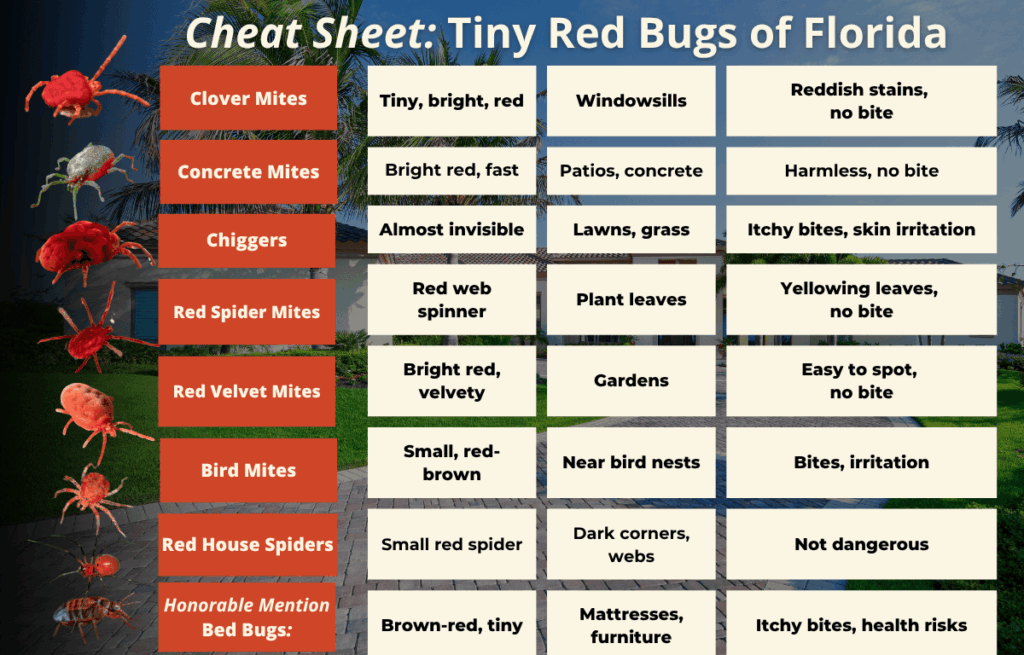
Clover Mites
Clover mites are the tiny, bright red specks most Florida homeowners find on windowsills, walls, and different types of siding. They measure about 0.75 mm, roughly the size of a pinhead. Their front pair of legs is much longer than the rest and often gets mistaken for antennae.
Key traits:
- Bright red to reddish-brown
- Oval body, eight legs
- Leave a red stain if crushed (this is pigment, not blood)
- Do not bite humans or pets
- Feed on grass, clover, and other plants
In North Florida, clover mites invade mostly in spring and fall, when temperatures swing. They slip in through cracks around windows and doors and can show up by the hundreds on sunny walls. The good news: they can’t breed indoors, and they die within a few days without plants to feed on.
Concrete Mites (Sidewalk Mites)
If the red specks are sprinting across your pool deck, driveway, or block wall on a sunny day, you’re likely looking at concrete mites. These are Balaustium mites. According to the Alabama Cooperative Extension System, they have longer bodies than clover mites, gather on concrete and masonry, and peak in spring and early summer.
Key traits:
- Bright red with a slightly long, narrow body
- About 1 to 2 mm, a little bigger than a clover mite
- Fast movers that love direct sun
- Found on concrete, stucco, pavers, and outdoor walls
- Feed on pollen and tiny insects
- Leave a red stain if crushed
- Generally harmless, with rare reports of mild skin irritation
People mix these up with clover mites all the time. Here’s the easy tell: concrete mites stay outside on hard surfaces, while clover mites head for your windows. Florida homes with stucco walls and paver patios give concrete mites plenty of room to roam.
Chiggers
Chiggers are the larval stage of a harvest mite (family Trombiculidae). At less than 1/150 of an inch, they’re almost invisible. You’ll rarely see a chigger, but you’ll feel its bite.
Key traits:
- Bright red larvae; adults are larger and don’t bite
- Live in tall grass, wooded edges, and leaf litter
- Bite by injecting enzymes that break down skin cells
- Leave intensely itchy red welts, often at the waistband, ankles, and behind the knees
- Do not survive indoors
Chiggers stay active through most of Florida’s long warm season, with the worst biting in summer. If you’re getting welts after time outdoors, see our guide to common bug bites and what they look like.
Red Spider Mites
Red spider mites (Tetranychus urticae) are a plant problem more than a house problem. They cluster on the undersides of leaves and spin fine webs. If your houseplants or garden plants are yellowing with tiny speckled spots, spider mites are a top suspect.
Key traits:
- Extremely small; live on plants
- Spin fine webbing on leaf undersides
- Do not bite humans
- Thrive in hot, dry conditions
Red Velvet Mites
Red velvet mites are the largest and easiest to see of the group. They have a bright red, fuzzy body. You’ll spot them outdoors on soil, sidewalks, or raised garden beds, often right after rain.
Key traits:
- Bright red with a velvety texture
- Larger than clover mites
- Harmless to people; stay outdoors
- Helpful in the yard: adults eat other mites and insect eggs
Bird Mites
Bird mites aren’t red to start. They turn reddish-brown after feeding on blood. If birds nest on or near your home and you start noticing tiny biting bugs indoors, bird mites are worth checking.
Key traits:
- Semi-clear to brown; reddish after feeding
- Bite humans after their bird host leaves or dies
- Can survive indoors for several weeks
- Often tied to nests in attics, eaves, or vents
Check your eaves, attic vents, and AC returns for nests. Our pest control services cover bird mite problems along with the usual suspects.
Red House Spiders
If your “tiny red bug” has a round body and sits in a tangled web, it’s a spider. The red house spider (Nesticodes rufipes) lives in warm places like Florida. Females are about 1/5 inch long with a reddish body and legs.
Key traits:
- Build messy webs in dark corners, garages, and behind furniture
- Eat ants and other small insects
- Not considered dangerous to people
The one red-marked Florida spider with a medically serious bite, the red widow, lives in the sand pine scrub of central and south Florida. It’s much bigger than a tiny red bug and isn’t a typical find around Jacksonville homes. For other spiders you might run into, read our wolf spider vs. brown recluse comparison.
Red Look-Alikes That Bite: Bed Bugs and Fire Ants
Two common Florida pests get called “little red bugs” even though they aren’t mites.
Fire ants are reddish-brown ants, about 1/8 to 1/4 inch long, that build dome-shaped mounds in lawns. They sting over and over and leave itchy white bumps. Six legs and antennae mean it’s an insect, not a mite.
Bed bugs are about the size of an apple seed (4 to 5 mm), flat, and reddish-brown. They look redder after feeding. Look for them in mattress seams, box springs, and headboards. Here’s how to tell a tick from a bed bug.
Clover Mites vs. Concrete Mites vs. Chiggers
These three cause the most confusion because they’re all tiny and bright red. Here’s how to tell them apart at a glance.
| Feature | Clover Mites | Concrete Mites | Chiggers |
|---|---|---|---|
| Size | ~0.75 mm (barely visible) | ~1 to 2 mm | ~0.2 mm (nearly invisible) |
| Color | Bright red to reddish-brown | Bright red | Bright red (larvae) |
| Where you find them | Windowsills, walls, siding | Patios, driveways, stucco, pavers | Grassy and wooded outdoor areas |
| Do they bite? | No | Generally no | Yes (larvae only) |
| Survive indoors? | Briefly, no food source | Rarely | No |
| Leave a stain? | Yes (red pigment when crushed) | Yes | No |
| Signs of their presence | Red specks crawling on surfaces | Fast red dots on sunny concrete | Itchy welts after outdoor time |
The simplest rule: red bugs inside with no bites means clover mites. Red bugs running on hot concrete means concrete mites. Itchy welts after walking through grass means chiggers.
If you’re also dealing with biting pests on your pets, read about what fleas look like to the human eye.
Where You’ll Find Tiny Red Bugs in and Around Your Home
Where you see the bugs is often the fastest clue to what they are.
- Windowsills and interior walls: Almost always clover mites, especially on the sunny side of the house.
- Patios, pool decks, driveways, and stucco: Concrete mites, most often in spring and early summer.
- Tall grass or wooded edges: Chiggers. Jacksonville-area parks, trails, and overgrown yards are prime spots.
- Plants and garden soil: Red spider mites (look for webbing) or red velvet mites (look for large red dots after rain).
- Near bird nests or in the attic: Bird mites, usually after a nest is abandoned.
- Dark corners, garages, and sheds: Red house spiders.
- Mattresses, baseboards, or furniture: If the bugs are larger, flat, and reddish-brown, check for bed bugs.
Trying to sort out a bigger pest picture? Our team wrote about the small insects Florida homeowners start seeing in spring.
How to Get Rid of Tiny Red Bugs and Keep Them Out
For most tiny red bugs, the fix is simple: vacuum the ones you see, don’t crush them, and change the outdoor conditions that draw them in.
Clover mites:
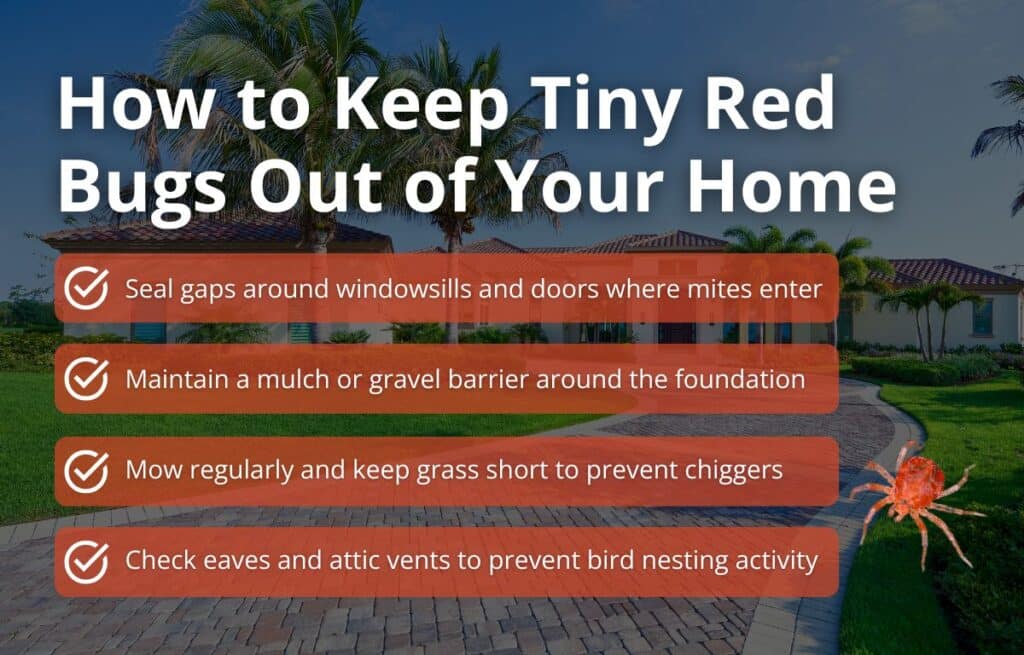
- Create an 18 to 24 inch strip of pea gravel or bare soil between your lawn and foundation
- Seal cracks around windows, doors, and siding with caulk (see how firestop caulking is applied)
- Go easy on lawn fertilizer near the house, since nitrogen boosts clover mite numbers
- Vacuum mites indoors and empty the canister outside
- Skip indoor bug sprays; clover mites don’t breed inside
Concrete mites:
- Rinse patios and walls with a garden hose
- Trim plants and ground cover that touch concrete or walls
- Be patient; numbers drop off as summer heats up
Chiggers:
- Mow often and keep grass under 3 inches
- Clear leaf litter and brush from yard edges
- Wear long pants tucked into socks and use a DEET-based repellent in grassy or wooded areas
- Shower and wash clothes soon after outdoor activities
Red spider mites:
- Water plants on a steady schedule
- Spray leaf undersides with water, neem oil, or insecticidal soap
- Remove heavily infested plants
Bird mites:
- Remove old nests once birds have left (many birds are protected, so check the rules first)
- Screen attic vents and seal gaps in eaves
Red house spiders:
- Knock down webs with a broom or vacuum
- Clear clutter in garages, closets, and sheds
Fire ants:
- Keep kids and pets away from mounds
- Treat mounds early, before they spread across the yard
What are the tiny red bugs crawling on my windowsill?
The tiny red bugs on your windowsill are almost certainly clover mites. These harmless, plant-feeding mites enter through gaps near windows and doors, mostly in spring and fall. They don’t bite, but they stain when crushed, so vacuum them up instead.
What are the tiny red bugs on my concrete patio?
Tiny red bugs running across a sunny patio, driveway, or stucco wall are usually concrete mites (Balaustium mites). They feed on pollen and tiny insects, rarely come indoors, and are generally harmless. A garden hose and trimming nearby plants is usually all it takes.
Do any tiny red bugs bite humans?
Some do. Chigger larvae bite and cause intense itching. Bird mites bite when their host bird is gone. Clover mites, concrete mites, red spider mites, and red velvet mites don’t bite. If “red bugs” bite you in bed, check for bed bugs.
Are little red spiders in Florida dangerous?
Most aren’t. The tiny red “spiders” people notice are usually clover mites or red house spiders, and neither is dangerous. Florida’s red widow has a serious bite, but it’s larger and lives in central and south Florida scrub, not typical Jacksonville yards.
What are the tiny red bugs in Florida grass?
Tiny red bugs in Florida grass are most likely chigger larvae or red velvet mites. Chiggers are nearly invisible but bite hard. Red velvet mites are larger and easy to see on soil after rain. Both like the warm, damp lawns common across Jacksonville and North Florida.
Are tiny red bugs harmful to pets?
Clover mites and concrete mites aren’t harmful to pets. Bird mites and chiggers can bite cats and dogs. If your pet is scratching a lot after time outdoors, call your vet before assuming mites are the cause.
Why do I suddenly have tiny red bugs in my house?
A sudden wave of tiny red bugs indoors usually means clover mites are moving in from the lawn. Weather swings in spring and fall push them toward sunny walls and into gaps around windows. Sealing cracks and adding a gravel strip at the foundation stops most invasions.ites.
When to Call a Professional
A few clover mites are easy to handle yourself. Call a pro when the problem keeps coming back or when bites are involved.
Call if you notice any of these:
- Red bugs keep returning indoors after you’ve sealed gaps and vacuumed
- Biting bugs are spreading to more rooms or family members
- Signs of bird mites in the attic, or birds nesting in or on the home
- Bites in bed or signs of bed bugs
- Fire ant mounds near play areas, patios, or the foundation
- A red bug you can’t identify after checking the types above
Our Jacksonville pest control team can identify the exact species, find entry points, and apply targeted treatments. We serve Jacksonville, St. Augustine, Orange Park, Ponte Vedra, and the surrounding areas of Northeast Florida.
Conclusion
Florida’s warm climate makes it a year-round home for tiny red bugs. Most are harmless. A few, like chiggers, bird mites, and fire ants, can cause real discomfort.
Key takeaways:
- Red specks on windowsills are clover mites: no bites, no health risk, easy to vacuum
- Fast red dots on sunny concrete are concrete mites, and they usually fade by summer
- Itchy welts after time in the grass point to chiggers
Not sure what you’re seeing, or tried DIY with no luck? Our team is ready to help. Schedule a service in Jacksonville or the surrounding areas today.